
Rtk Autosteer For Tractors Explained
RTK autosteer for tractors explained in plain language: it is a guidance system that uses RTK-corrected satellite positioning to steer your tractor automatically along precise, repeatable lines, so you can work hands-free while cutting overlaps, misses, and driver fatigue. The core promise is accuracy. Ordinary GNSS gets you metre-level positioning; RTK pulls that down to roughly 1–2 cm under good conditions, with pass-to-pass repeatability commonly quoted between 2–5 cm. That centimetre band is the threshold that makes reliable autosteer, precision planting, strip-till, and repeatable row passes across seasons actually work. This guide breaks down how RTK improves accuracy, how the tractor physically steers itself, what hardware and software you really need in the cab, and how we at Agro Navigator fit that picture with a native iPad and iPhone app.
Table of contents
- • What "RTK Autosteer for Tractors" Actually Is
- • How RTK Autosteer Works: From Satellites to Steering Valves
- • The Hardware and Software Pieces in a Modern System
- • Where Agro Navigator Fits in RTK Autosteer
- • Is RTK Autosteer Right for Your Operation?
- • Risks, Limitations, and Practical Realities
- • Frequently Asked Questions
What "RTK Autosteer for Tractors" Actually Is
A tractor guidance system is the combination of GNSS positioning and automated steering control that keeps a machine on precise, repeatable paths across the field. In its simplest form, guidance can be a lightbar that helps the operator steer manually. In its most advanced form, autosteer takes over the steering entirely, controlling the wheels or a hydraulic valve so the tractor holds the planned line with minimal driver input.
RTK, or Real-Time Kinematic, is a GNSS correction technique that compares the tractor's raw satellite signals against a known reference and removes atmospheric and orbital errors in real time. By streaming those corrections from a base station or an RTK network to the receiver on the tractor, RTK pulls horizontal accuracy into roughly the 1–2 cm band under good conditions and delivers pass-to-pass repeatability commonly within about 2.5 cm.
The three pieces work together in a straight line of logic. RTK provides the centimetre-level position. The guidance controller compares that position to the planned guidance line and calculates cross-track error, meaning the distance between where you are and where you should be. Autosteer hardware then turns the steering wheel or controls hydraulic steering valves to drive that error toward zero, keeping the tractor precisely on the line.
When you search for how RTK autosteer for tractors is explained, you are usually trying to understand three things at once: how RTK improves accuracy, how the tractor actually steers itself, and what hardware and software are genuinely required in the cab. The rest of this guide answers each in turn. For a broader view of guidance categories and how they map to cost, our guide to tractor guidance systems sets the wider context.
How RTK Autosteer Works: From Satellites to Steering Valves
Every autosteer system is built around the same positioning-and-control pipeline, even when brands package it differently. Understanding that pipeline is the fastest way to judge any product you are shown.
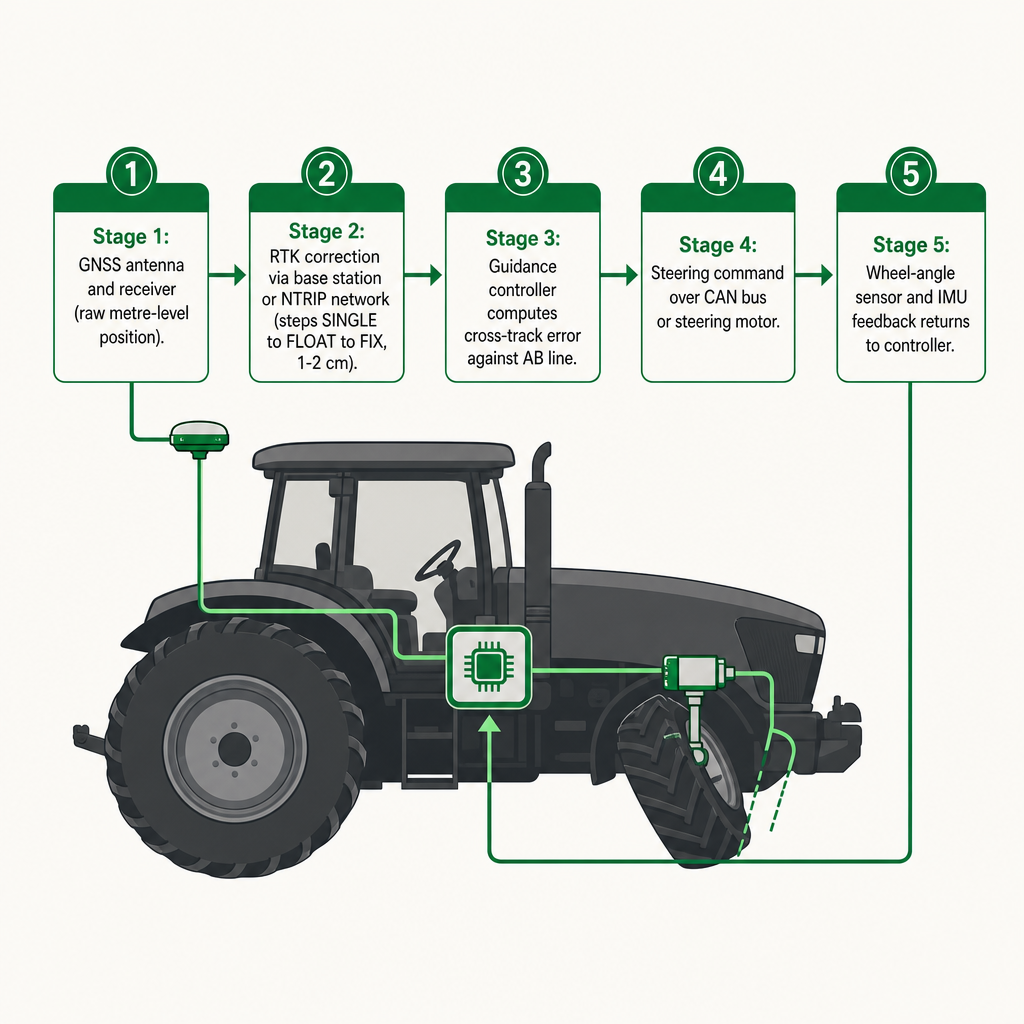
First, a roof-mounted GNSS antenna and receiver lock onto multiple satellite constellations such as GPS, GLONASS, Galileo, and BeiDou to determine the machine's raw position. On their own, these signals give metre-level accuracy, which is enough to know which part of a field you are in but not enough to drive passes on 30 cm rows without overlap or gaps.
RTK corrections then refine that position. A fixed base station, or a commercial RTK network, knows its true coordinates, compares them to what the satellites report, calculates the error, and sends correction data to the tractor over radio or cellular using NTRIP. The receiver steps its solution from SINGLE to FLOAT to a FIX state. Only a FIX solution delivers the advertised 1–2 cm accuracy that high-value operations such as strip-till and precision seeding depend on.
Inside the tractor, the guidance controller continuously compares the RTK-corrected position and heading to the planned path, whether that is a straight AB line, a curve, or a contour, and computes steering commands. On steer-ready tractors, those commands are often sent digitally over the tractor's CAN bus to factory hydraulic steering valves. On retrofitted machines, they may drive an electric steering motor bolted to the steering wheel or a retrofit hydraulic valve kit.
Sensors close the loop. A wheel-angle sensor reports the actual steering angle so the controller can correct overshoot. An IMU or a dual-antenna GNSS arrangement compensates for roll and tilt on slopes, keeping the tractor on the line even when the implement pulls it sideways. All of this runs many times per second, so autosteer feels smooth and natural to the operator while staying within a few centimetres of the guidance line.
The Hardware and Software Pieces in a Modern System
Modern RTK autosteer setups, including open-platform systems based on AgOpenGPS, revolve around a similar set of components. Knowing them lets you separate genuine capability from marketing.
- A multi-constellation RTK GNSS receiver and roof-mounted antenna that supply centimetre-level position to the guidance system.
- An RTK correction source, which can be a local base station, a commercial network, or a national RTK service, delivered over UHF radio or IP using NTRIP over cellular or another internet link.
- A control ECU and PCB that route power, read the wheel-angle sensor and IMU, and drive the steering actuator or interact with CAN-based factory valves.
- Steering actuation hardware, either an electric motor on the steering wheel, a retrofit hydraulic valve kit, or an interface to the tractor's steer-ready hydraulics over CAN bus.
- A guidance computer and interface software that display field maps, guidance lines, and machine status, and let the operator engage or disengage autosteer and manage jobs.
AgOpenGPS itself is an open-source guidance and autosteer platform that grew from a simple parallel-driving aid into a full autosteer and section-control system, with community-designed hardware boards and steering kits that use off-the-shelf GNSS modules such as the u-blox ZED-F9P. Traditional AgOpenGPS builds rely on a Windows tablet or laptop in the cab, connected over USB or Ethernet to RTK GNSS receivers and autosteer control boards, with a built-in NTRIP client pulling corrections from public or commercial RTK casters. That Windows dependency is the single point most farmers want to remove, and it is where the design choices in modern mobile systems become interesting.
Where Agro Navigator Fits in RTK Autosteer
We built Agro Navigator around a specific idea: deliver RTK GPS autosteer through hardware you install once and a native mobile app running on the iPad or iPhone already in your cab, without needing a Windows PC on the seat. Rather than a phone-only steering novelty, we pair dedicated autosteer hardware with native iOS and Android apps. The mobile device becomes the field cockpit while external hardware does the steering and positioning work.
In our workflow, the iPad or iPhone is the operator interface for field navigation, job setup, diagnostics, and live machine status. It is not the RTK receiver and it is not the steering controller. A supported external RTK GNSS receiver and antenna provide the centimetre-level position, while an ECU and control electronics connect to steering sensors and actuators, including CAN bus integration for steer-ready tractors. Our base wired autosteer model connects to the iPad or iPhone over Ethernet-over-USB, so guidance and autosteer control run as a native iOS app while the controller handles low-level hardware and safety.
Because we are built on the open-source AgOpenGPS platform, our system is designed to work with the existing community ecosystem: AgOpenGPS-compatible PCBs, wheel-angle sensors, steering motors or hydraulic kits, and popular RTK GNSS boards such as simpleRTK2B and similar F9P-based receivers. Two hardware configurations are available. The base wired model connects over Ethernet-over-USB, and an advanced version adds a built-in 4G/GSM modem for live telemetry, remote machine monitoring, and fleet management through an online dashboard.
Our real advantage is straightforward. We remove the Windows laptop requirement from typical AgOpenGPS builds without pretending the tablet replaces serious GNSS or steering hardware. The ECU, GNSS receiver, correction link, wheel-angle sensing, and steering actuator remain separate, purpose-built components. What changes is the in-cab experience, which becomes a native mobile app on a device you likely already run. If you want the practical checklist of what a no-Windows setup requires, our breakdown of RTK GPS autosteer for iPad and what the setup actually requires covers the component list in detail.
Is RTK Autosteer Right for Your Operation?
The decision to invest in RTK autosteer is less about whether the technology works, since it is mainstream in precision agriculture, and more about whether its capabilities match your agronomy, machinery, and business.
Crops and operations. RTK-grade autosteer delivers the most value where pass-to-pass accuracy and repeatability matter: precision planting on narrow rows, strip-till, variable-rate applications, controlled-traffic farming, and high-value specialty crops. If your main tasks are broadacre tillage or rough fertilizer spreading, where an overlap of half a metre is not critical, mid-tier GNSS guidance may already cover most of your needs without full autosteer.
Tractor readiness and hardware path. Steer-ready tractors with factory CAN-bus hydraulic steering and dedicated autosteer ports are significantly easier to integrate, because an external system can plug into existing wiring and valves with minimal mechanical modification. Older tractors without steer-ready hardware usually require a retrofit steering motor on the wheel or an aftermarket hydraulic valve kit, plus installation of wheel-angle sensors and control boards. That adds mechanical work and cost, but it is technically straightforward with modern open-platform kits.
Platform and ecosystem choices. Closed guidance systems from major OEMs wrap the receiver, corrections, display, and autosteer licenses into proprietary packages. That can be convenient, but it tends to lock you into one vendor's hardware and subscription model. Open-platform solutions based on AgOpenGPS favour off-the-shelf GNSS modules, community-designed boards, and flexible correction sources, trading some polished integration for lower cost and more control. We built Agro Navigator for this second group: farmers who want AgOpenGPS-grade control logic and hardware freedom but prefer a native iOS or Android interface over maintaining a dedicated Windows laptop.
Fleet management and telemetry. RTK autosteer is the backbone of many fleet workflows. Once machines drive accurately and jobs are logged digitally, it becomes practical to layer on live telemetry, remote monitoring, and web dashboards that track machine locations, status, and task progress in near real time. This matters most for small-to-medium operations coordinating several machines, and for dealers or fleet managers who support multiple customers and need to diagnose issues remotely. Our advanced hardware version, with its built-in modem and online dashboard, is aimed squarely at this need.
Cost and adoption strategy. Open-source autosteer case studies with AgOpenGPS have reported hardware costs in the range of roughly €1,450–€2,350, depending on whether steering is handled by a motor or hydraulics, with installation on the order of a working day per tractor. Layering on RTK corrections and mobile-app control hardware adds its own cost profile, but the open-platform approach lets you reuse existing RTK receivers and spread investment across multiple machines and seasons rather than buying one sealed system per tractor.
Risks, Limitations, and Practical Realities
RTK autosteer is mature technology, but it is not magic. The practical risks cluster around signal reliability, integration quality, and operational discipline.
Signal and correction reliability. RTK depends on continuous satellite reception and a stable correction link. Tree lines, building shadows, and terrain can degrade satellite visibility, while cellular dead zones or unstable radio links can interrupt correction streams, pushing the solution from FIX back to FLOAT or SINGLE and temporarily degrading accuracy. For critical operations such as strip-till and precision planting, the sensible response is to monitor RTK status in the cab, plan around known cellular weak spots, and consider a local base station where consistent coverage is essential.
Integration and safety. Steering hardware must be installed and calibrated correctly. Wheel-angle sensors, motors or valves, and CAN bus connections have to be wired, configured, and tested so that steering commands translate into predictable wheel movement and the system fails safely if a component misbehaves. On steer-ready tractors, incorrect CAN wiring or a misidentified port can cause unreliable steering or diagnostic errors. On retrofits, a misaligned steering motor or a poorly mounted sensor can cause oscillation or drift. Autosteer supports the operator rather than replacing them: the driver stays responsible for supervision, for disengaging in unsafe situations, and for confirming that guidance lines and implement settings are correct.
Software and ecosystem evolution. Open-platform ecosystems like AgOpenGPS evolve continuously through firmware updates, new board revisions, and community-driven improvements. That brings rapid innovation alongside a real need for ongoing updates and configuration management. Our own native iOS and Android apps are in early access and are being refined on field feedback, with future autonomy features such as predefined path driving and multi-vehicle coordination planned. Farmers adopting them now should expect feature evolution and occasional adjustments as the software and hardware mature. If you are weighing this against a proprietary display, our comparison of precision farming on an iPad without a Windows PC explains the trade-offs in plain terms.
Frequently Asked Questions
What accuracy does RTK autosteer actually deliver?
RTK-corrected GNSS brings horizontal accuracy down to roughly 1–2 cm under good conditions, with pass-to-pass repeatability commonly quoted around 2–5 cm. That is enough for precision planting, strip-till, and repeatable guidance lines across seasons, provided the receiver holds a FIX solution.
Can an iPad or iPhone replace an RTK GNSS receiver and autosteer controller?
No. In our system, the tablet provides the screen, controls, and network connection, but a supported external RTK GNSS receiver, an ECU, and steering hardware still perform the precision positioning and steering. "No Windows PC" means removing the laptop, not eliminating dedicated hardware.
Do I need a steer-ready tractor for RTK autosteer?
No, but a steer-ready tractor simplifies installation because factory hydraulic valves and CAN bus wiring are already in place, so the autosteer system can plug into dedicated ports. Non-steer-ready tractors can be fitted with an electric steering motor or an aftermarket hydraulic kit, at the cost of additional installation work.
Can I reuse existing AgOpenGPS boards and RTK receivers with Agro Navigator?
Because we are built on the AgOpenGPS platform, our system is designed to be compatible with community-standard autosteer PCBs and popular RTK GNSS modules such as F9P-based boards. That makes it suitable for AgOpenGPS users who want a native iOS or Android experience while keeping their existing hardware ecosystem.
Who is RTK autosteer most beneficial for?
It is most valuable for independent farmers and small-to-medium operations doing precision planting, strip-till, controlled-traffic farming, or high-value crops, and for fleet managers and dealers who benefit from accurate digital job records, live telemetry, and vendor-neutral hardware that can be deployed across multiple tractors and seasons.